
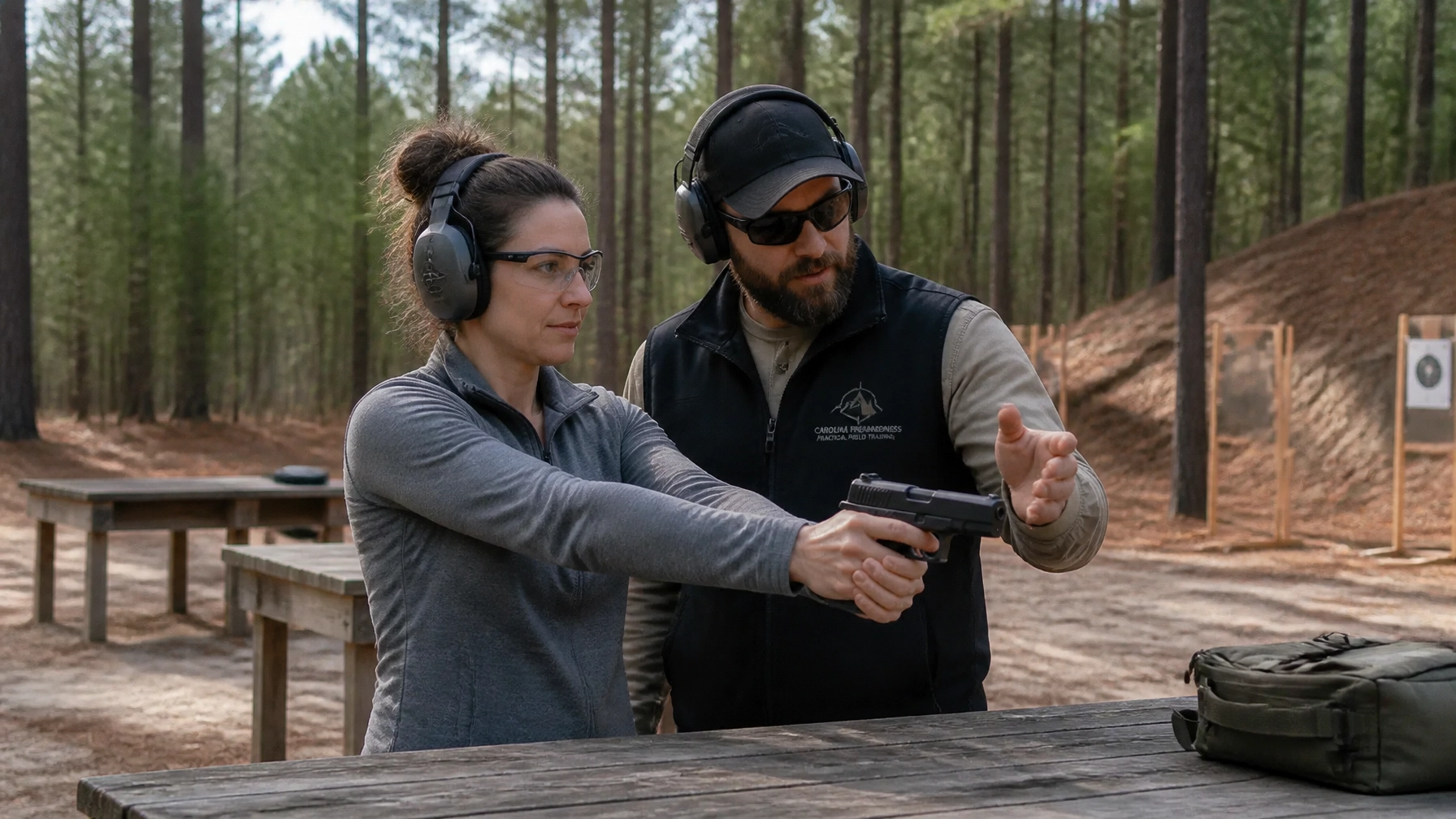
Many people want to learn about firearms but feel unsure about where to start. That is normal. Safe firearms handling is a learned skill, and beginners should not be expected to know the terminology, equipment, or range procedures before training.
The right firearms training for beginners starts with clear instruction, steady practice, and a calm environment. The goal is not speed or bravado. The goal is to handle a firearm safely, understand your responsibilities, and make sound decisions under supervision.
Carolina Preparedness teaches practical skills from the ground up : browse the Firearms & Personal Safety course category to see available options and request future classes.
What beginner firearms training should cover
A solid introductory course should cover more than how to fire a gun. It should help you understand the full process of responsible ownership.
Most beginner courses include:
- Basic firearm parts and terminology
- The difference between common firearm types
- Safe handling and safe direction
- Loading and unloading procedures
- Ammunition basics
- Grip, stance, sight alignment, and trigger control
- Range commands and etiquette
- Eye and ear protection
- Safe storage and transport
- Cleaning and basic maintenance
- Local legal responsibilities, when appropriate
- Supervised range practice
The specific content depends on the class. A basic pistol course is different from a concealed carry course, private instruction, or an advanced practical pistol class. Start with the course that matches your experience : not the course that sounds most advanced.
Carolina Preparedness lists NRA Basic Pistol as a beginner-level course covering safe handling, marksmanship, and range fundamentals. The course catalog also includes private firearms instruction for students who prefer individual coaching.
The four basic firearm safety rules
Different organizations may word the rules slightly differently. The basic ideas remain consistent.
1. Treat every firearm as if it is loaded
This is a safety mindset, not a statement about the firearm’s actual condition. Keep the same level of care whether you believe a firearm is loaded, unloaded, or cleared.
2. Keep the muzzle pointed in a safe direction
A safe direction is one where an unintended discharge would not injure a person or cause unacceptable damage. At a range, this usually means downrange and toward the backstop.
3. Keep your finger off the trigger until you are ready to fire
Keep your trigger finger straight and alongside the frame until you have made the decision to shoot and your sights are on the target.
4. Know your target and what is beyond it
A target is only part of the shooting environment. You must also understand what lies behind it and where a missed shot could travel.
The NRA Gun Safety Rules provide another useful reference. Reading safety rules is helpful : practicing them under direct instruction is better.

What your first class may look like
A beginner class usually begins away from the firing line. The instructor may introduce the firearm, explain the controls, review safety rules, and answer basic questions before any live ammunition is used.
This first stage matters. It gives you time to learn the process without managing noise, recoil, or the pressure of a live-fire exercise.
A typical class may follow this sequence:
- Safety briefing
The instructor explains the rules, range procedures, emergency commands, and required protective equipment. - Firearm orientation
You learn the names and functions of the main parts. You may practice identifying whether the firearm is loaded or unloaded under supervision. - Demonstration
The instructor shows the correct grip, stance, sight alignment, trigger control, and handling procedures. - Dry practice
You rehearse movements with an unloaded firearm or training aid. This helps you focus on safe technique before adding live fire. - Supervised live fire
When the instructor determines you are ready, you practice on the range. The pace should remain controlled, with safety taking priority over speed. - Review and next steps
The instructor identifies areas to practice and explains what training should come next.
A well-run class gives you permission to pause. If a command is unclear, a firearm feels unfamiliar, or you need a second explanation, ask before continuing.
How to choose a beginner-friendly course
Course descriptions can tell you a great deal about the learning environment. Look for these features:
- The course clearly states that beginners are welcome.
- Prior experience is not required.
- Safety and responsible handling are central topics.
- The class includes hands-on practice.
- The instructor is appropriately certified or qualified.
- The class size allows for individual guidance.
- The course explains what equipment you need.
- Loaner firearms or other accommodations are available when offered.
- The course does not require advanced skills as a starting point.
Carolina Preparedness states that many introductory classes require no prior experience. The school is led by Forrest Garvin, an NRA-certified firearms instructor with more than 25 years of teaching experience. Its approach is practical and direct : students learn useful skills without fear-based messaging or pressure to perform.
If you are unsure which course fits, use the contact page to describe your experience and goals.
Confidence comes from repetition
Confidence does not mean feeling excited or completely comfortable on the first day. It means knowing what to do, knowing what not to do, and being able to repeat safe actions consistently.
Focus on process rather than performance:
- Follow the safety rules every time.
- Use the same safe loading and unloading sequence.
- Keep your finger indexed until you are ready to fire.
- Listen for range commands.
- Let the instructor set the pace.
- Ask questions before guessing.
- Stop if something feels unclear.
- Practice only as directed by a qualified instructor.
Accuracy can improve over time. Safe habits must come first.
You do not need to buy an expensive firearm or a large amount of equipment before taking an introductory course. Start by learning what fits your goals, hand size, experience, and intended use. A supervised class can help you make better decisions later.
Storage is part of firearms training
A firearm is not safe simply because it is not being used. Responsible ownership includes what happens when the firearm is stored, transported, or handled by someone else.
Your training should address:
- Secure storage at home
- Preventing unauthorized access
- Separate and secure ammunition storage
- Transport requirements
- Safe handling around family members and visitors
- A household plan for what to do if someone finds a firearm
Storage decisions should account for the people in your home, including children, guests, and anyone who may be at increased risk of self-harm. Choose a secure method that prevents unauthorized access while still fitting your lawful needs.
For current legal requirements, consult official North Carolina sources or a qualified legal professional. Laws and policies can change : confirm the rules that apply to your location and situation.

When to consider concealed carry training
A beginner pistol class and a concealed carry course serve different purposes.
A basic course helps you learn safe handling and shooting fundamentals. A concealed carry course may add state law, carrying considerations, storage, cleaning, and qualification requirements.
Carolina Preparedness offers a North Carolina Concealed Carry Permit Course. The course includes classroom and range instruction, handgun safety, safe storage, ammunition, marksmanship fundamentals, cleaning, and North Carolina handgun laws relevant to the permit process.
You do not need to begin with concealed carry training if your first goal is simply to learn safe handling. Start with the level that matches your current skills : then build from there.
Training is a practical first step
Firearms training for beginners should make the process more understandable, not more intimidating. You should leave with a clearer understanding of safe handling, range procedures, personal responsibility, and the skills that need more practice.
Carolina Preparedness keeps instruction hands-on and beginner-friendly, with courses across firearms, personal safety, preparedness, and outdoor skills. Review the Firearms & Personal Safety courses when you are ready.
SEO Fields
Excerpt: Firearms training for beginners should be calm, practical, and safety-focused. Learn what to expect in a first class and how hands-on instruction builds responsible confidence.
SEO title: Firearms Training for Beginners | Carolina Preparedness
Meta description: Learn what to expect from firearms training for beginners, including safety rules, range procedures, supervised practice, storage, and responsible ownership.
Focus keyword: firearms training for beginners
Featured image alt text: Instructor calmly coaching a beginner through safe firearm handling during an outdoor firearms training class
Tags: firearms training for beginners, firearm safety, beginner firearms course, personal safety training, gun safety, responsible firearm ownership, firearms instruction, Carolina Preparedness