
Most home-security plans begin too late.
They begin after a break-in. After a storm knocks out power. After a neighborhood disruption changes normal routines.
By then, the weaknesses are already visible.
A dark side yard. An unlocked gate. A hollow exterior door. Shrubs hiding a window. A garage door that stays open. A family that has never practiced what to do when something feels wrong.
Home security is not about turning your property into a fortress. It is about building layers that deter, detect, delay, and communicate.
If your doors are strong but your yard provides concealment, your plan is incomplete.
If you own cameras but never test them, your plan is incomplete.
If your family has equipment but no shared response procedure, your plan is incomplete.
The standard is simple: skill over gear, systems over one-time fixes.
Start With a Perimeter Walk
You cannot secure what you have not inspected.
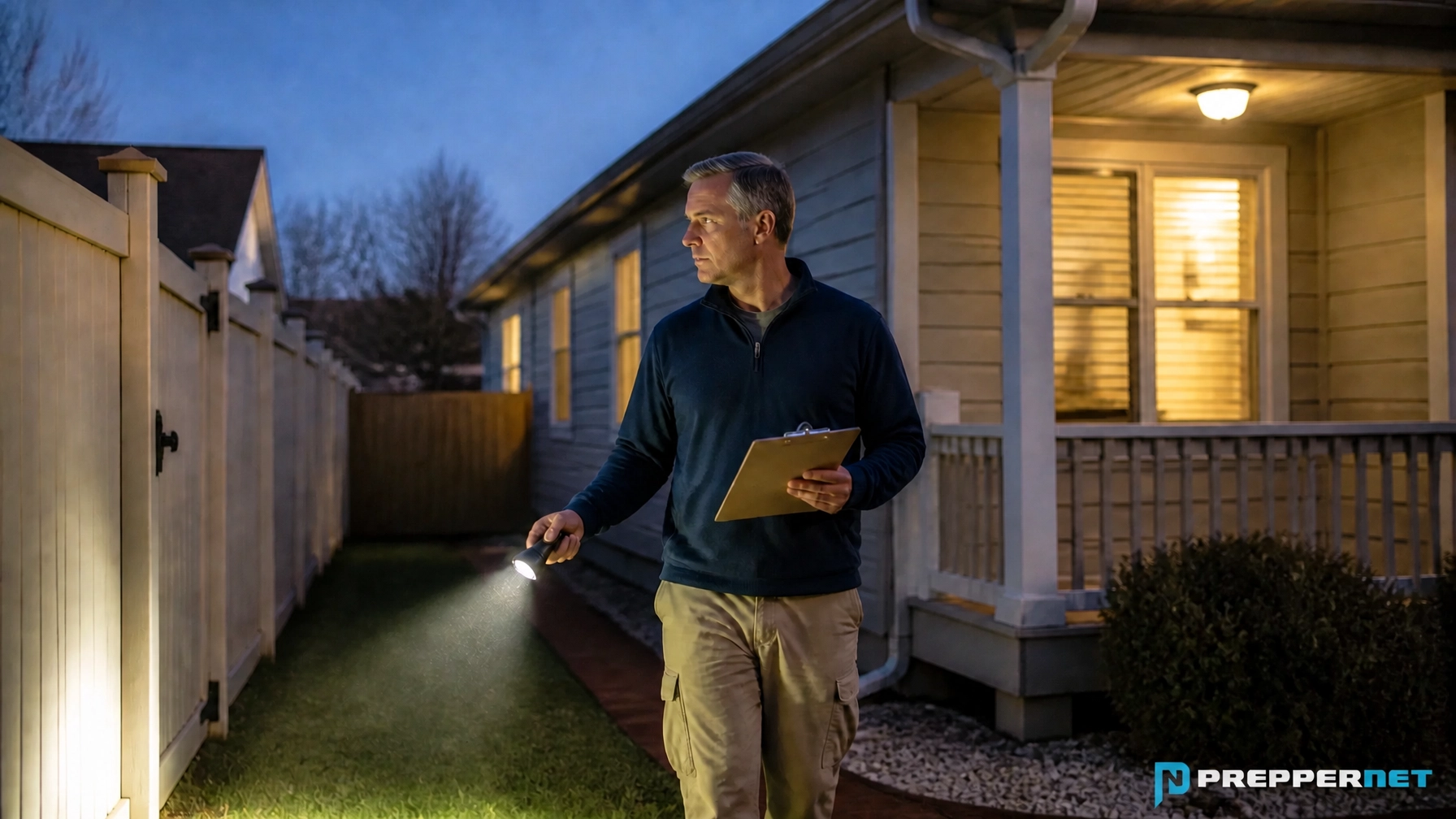
Walk your property during daylight. Then walk it again after dark. Use a notebook or a printed sketch of your home and mark:
- Every entrance and exit
- Gates and fence gaps
- First-floor windows
- Windows near porches, decks, sheds, or low roofs
- Dark areas around the house
- Places where shrubs or structures block visibility
- Exterior utility panels and equipment
- Ladders, tools, bins, furniture, or other climbable objects
- Routes from the street, alley, woods, or neighboring properties
Do not inspect from the front porch and assume the rest is fine.
Walk the side yards. Check the rear property line. Look at the garage. Stand outside each bedroom window and ask whether someone could approach without being seen.
The Canfield Police Department residential security manual reflects a common crime-prevention principle: visibility and properly secured entry points are among the most practical ways to reduce opportunity.
Action Items
- Complete one daytime perimeter walk.
- Complete one nighttime perimeter walk.
- Photograph problem areas for later correction.
- Rank each weakness as high, medium, or low priority.
- Fix the easiest high-priority problems first.
Layer One: Make the Property Visible
Security landscaping is not about making your property look intimidating.
It is about removing hiding places and improving observation.
Keep shrubs trimmed below window level where possible. Prune low branches from trees. Remove vegetation that touches fences, walls, or the house. Keep the area around gates and doors clear enough that neighbors can see activity.
Do not create a blind tunnel between the street and your back door.
Do not place dense landscaping directly in front of ground-floor windows.
Do not leave stacked firewood, ladders, trash bins, or patio furniture next to a fence. These objects can provide concealment or help someone climb.
Fences can create privacy, but privacy can work both ways. A tall, solid fence may keep your family out of view while also hiding unwanted activity. Consider where you need privacy and where you need visibility.
Your goal is controlled access, not total concealment.

Action Items
- Trim shrubs that block doors or windows.
- Clear at least the main approach routes to your home.
- Secure gates with dependable latches and locks.
- Repair broken fence sections and loose posts.
- Move climbable objects away from fences and windows.
- Check local rules before changing fence height or adding security features.
Layer Two: Use Lighting Correctly
A light that blinds your family but leaves the approach dark is not a good security light.
Install lighting where it improves identification and removes shadows around:
- Front and rear doors
- Driveways and walkways
- Side yards
- Gates
- Garage entrances
- Building corners
- Common approach routes
Use steady dusk-to-dawn lighting for general coverage. Use motion-activated lighting for areas where you want an alert that someone has entered the space.
Walk your property after dark and test the lights yourself.
Check for glare. Check for dead zones. Check whether the motion sensor activates too late. Make sure lights do not shine directly into cameras or create bright reflections that reduce image quality.
Lighting is not a substitute for locks. It is one part of a layered system.
If you have cameras but poor lighting, identification may be difficult.
If you have good lighting but no notification system, you may not know when someone enters the property.
Use both where appropriate.
Layer Three: Harden Doors and Frames
A strong lock installed in a weak door frame does not provide strong security.
Inspect every exterior door, including the door between your garage and home. Treat that garage-to-house door like an exterior entrance.
Prioritize:
- Solid-core or metal exterior doors
- Quality deadbolts
- At least a one-inch deadbolt throw where compatible with the door
- Reinforced strike plates
- Long screws anchored into structural framing
- Strong door jambs
- Hinges that cannot be easily removed from the exterior
- Working locks on basement and side doors
The frame matters as much as the lock. A short screw secured only into decorative trim is not the same as a long screw anchored into the wall framing.
Sliding glass doors require separate attention. Use a properly fitted security bar or dowel in the track, and confirm that the door cannot be lifted out of the frame. Do not block a required emergency exit without understanding the fire-safety consequences.

Action Items
- Test every exterior door for looseness and frame movement.
- Replace damaged or hollow exterior doors.
- Inspect strike plates and deadbolt alignment.
- Replace loose short screws with appropriate longer fasteners.
- Secure sliding doors without compromising emergency egress.
- Keep keys controlled and do not hide them in obvious outdoor locations.
Layer Four: Secure Windows Without Creating a Fire Hazard
Ground-floor windows deserve the same attention as doors.
So do windows above porches, decks, roofs, and other structures that make access easier.
Confirm that every window closes fully and has a working lock. Add secondary pins or locks where appropriate for sliding windows. Consider security film for vulnerable glass. For high-risk areas, stronger glazing or professionally installed security products may be appropriate.
But do not install bars or restraints that prevent your family from escaping during a fire.
Every bedroom should have a known emergency exit. Every member of the household should understand how to use it.
Security and fire safety must work together.
If a security improvement traps someone during an emergency, it is not an improvement.
Action Items
- Check every ground-floor window lock.
- Inspect windows near decks, porches, and low roofs.
- Keep landscaping below the sill where practical.
- Test bedroom emergency exits.
- Replace damaged window hardware.
- Review any bars, pins, or restraints for code compliance and emergency release.
Layer Five: Add Detection, Then Practice
Cameras, alarms, driveway alerts, and door sensors can help. They are not magic.
A camera that points at an empty section of the yard is not useful. A sensor with dead batteries is not useful. An alarm system no one knows how to arm is not useful.
Place detection tools at meaningful points:
- Main doors
- Gates
- Driveways
- Side-yard approaches
- Garage entrances
- Areas where someone would have to pass to reach the home
Protect your privacy while using technology. Change default passwords. Enable multifactor authentication when available. Keep software updated. Decide who can access recordings and notifications.
Then practice.
Have your household answer these questions:
- Who checks an alert?
- Who calls for help?
- Where do family members gather?
- What happens if a phone or internet connection fails?
- What is the difference between a suspicious noise and a confirmed emergency?
- When do you stay inside, leave, or contact a neighbor?
Do not turn a security plan into an excuse for confrontation. The priority is safety, awareness, communication, and contacting appropriate emergency services.
The Seven-Day Home Hardening Plan
You do not need to solve everything in one weekend.
Day 1: Inspect
Walk the property and list every weakness.
Day 2: Improve Visibility
Trim shrubs, prune branches, and remove unnecessary concealment.
Day 3: Fix Access
Repair gates, locks, doors, and windows. Start with the most vulnerable entry point.
Day 4: Correct Lighting
Replace failed bulbs, reposition fixtures, and test motion sensors.
Day 5: Improve Detection
Check camera angles, sensor batteries, alarm settings, and notification access.
Day 6: Build the Household Procedure
Write a one-page plan. Include emergency contacts, meeting locations, evacuation routes, and responsibilities.
Day 7: Practice
Run a short drill. Test the lights. Lock the doors. Walk the escape routes. Confirm everyone understands the plan.
Then repeat the inspection every season.
Home security is a maintenance system. Plants grow. screws loosen. batteries fail. Family routines change.
Common Questions
Should I install cameras before reinforcing my doors?
No. Start with the physical weaknesses that provide easy access. Detection is valuable, but a camera does not compensate for an unsecured door.
Are motion lights enough?
No. They improve visibility and may deter opportunistic activity. They do not replace locks, awareness, or a response plan.
Should I build a tall privacy fence?
It depends on your property and local rules. A fence can control access, but it can also reduce visibility. Balance privacy with observation.
Should I buy expensive security equipment?
Not first. Start with inspection, lighting, locks, maintenance, and practice. Skill over gear applies to home security too.
What is the most important improvement?
Secure the entry point that is easiest to reach and weakest to defeat. For many homes, that means a rear door, garage-to-house door, sliding door, or concealed ground-floor window.
Build Security With People, Not Just Equipment
A safer home is valuable.
A connected neighborhood is stronger.
Know who lives nearby. Share contact information with trusted neighbors. Learn about local emergency resources. Participate in practical training. Discuss severe-weather plans, power outages, and communication problems before they become urgent.
PrepperNet is built around this principle: preparedness works better when people share knowledge and build real relationships. Use the PrepperNet meetup group directory to find a local group. You can also review the PrepperNet preparedness resources and learn more about the network’s community-first mission.
Your perimeter is not just a fence.
It is your visibility, lighting, doors, windows, habits, communications, and relationships.
If you harden one part but ignore the rest, the system remains weak.
Start with one inspection. Fix one vulnerability. Practice one procedure.
Then keep building.
Metadata Summary
- SEO title: Home Security Fundamentals: How to Harden Your Perimeter
- Meta description: Learn practical home-security fundamentals for hardening doors, windows, lighting, landscaping, detection, and family response before a crisis.
- Excerpt: A practical, layered system for improving home security before a crisis. Inspect your perimeter, remove vulnerabilities, harden entry points, improve lighting, and practice with your household.
- Featured image alt text: Homeowner inspecting the perimeter of a suburban house with a flashlight and checklist
- Category assigned: Preparedness
- Target SEO keywords: home security fundamentals, perimeter security, how to harden your home, home perimeter hardening, residential security checklist, door security, window security, security lighting, preparedness, family emergency planning, home defense basics, self-reliance