A move does not have to end a mutual assistance group.
People relocate for work, family, health, or opportunity. The group changes when they leave. It does not have to disappear.
We can keep the relationship useful with clear expectations, regular check-ins, shared contacts, and rotating hosts. The goal is not to pretend distance does not matter. The goal is to plan around it.
A mutual assistance group works because people trust one another and contribute useful skills. Gear supports that work. Community makes it possible.
Community remains the number one prep
We can store food, water, medical supplies, tools, and fuel. Those preparations matter. They still cannot replace trusted people.
A distant MAG member may no longer help with a local supply run or welfare check. They may still provide valuable support. They can maintain outside contacts, share specialized knowledge, help with relocation planning, monitor regional events, or connect the group with resources.
This reflects a basic lesson from The Prepping Academy episode on building a MAG. We should build relationships before we need them. We should also maintain those relationships after circumstances change.
Faith gives us a useful framework for this work.
Preparedness is an act of stewardship. We care for our households, our neighbors, and the responsibilities placed in front of us. Proverbs 27:12 reminds us to see danger and take prudent action. Ecclesiastes 4:9-10 teaches that people are stronger when they support one another.
We do not prepare from fear. We prepare so we can serve with calm judgment.
A member who moves away may still be part of that mission. The group should decide what that role looks like.
Update the member’s role before the move
Start with a direct conversation.
Ask what the member can realistically do from the new location. Do not create obligations based on old assumptions. Distance changes response times, travel costs, availability, and local knowledge.
Write down the answers in a simple group agreement.
Cover these points:
- New city, region, and time zone.
- Primary and backup contact methods.
- Emergency contact information.
- Skills and useful resources.
- Availability during normal conditions.
- Availability during a regional emergency.
- Expected meeting and check-in schedule.
- Information the member can access.
- Information the member no longer needs to access.
- Whether the person remains a full, remote, or affiliate member.
Keep the record limited. Do not place sensitive addresses, supply locations, access codes, or private family information in a widely shared file.
A short policy can prevent confusion:
Members who relocate may remain remote members by mutual agreement. They will keep their contact information current, participate in scheduled check-ins, support agreed responsibilities, and have a local backup for any task that requires an in-person response.
This gives everyone a clear starting point.
Build a simple communications plan
Distance makes communication more important. It also creates more ways for communication to fail.
The group should maintain a primary method and at least two backups. Keep the plan simple enough to remember.
For example:
- Primary: Group text or a private messaging app.
- Backup: Scheduled phone or voice check-in.
- Contingency: Radio, email, or an agreed out-of-area contact.
- Final option: A trusted person who can pass a message between locations.
Do not assume a channel works because it worked last year. Test it.
Set a regular check-in window. A monthly check-in may be enough for normal conditions. A weekly check-in may make sense during severe weather, widespread outages, or a known regional threat.
Use simple status messages:
- OK: No assistance needed.
- Need assistance: A specific need exists.
- Cannot respond: The person may be safe, but communication is not available.
Avoid complicated codes. Confusing language slows decisions.
The Prepping Academy episode “What Threats to Communications Systems Should We Prep For?” makes an important point. Communications equipment only helps when people know how to use it. Practice matters more than collecting another device.
Test the plan during an ordinary month. Ask each member to confirm receipt. Run one check-in using the backup channel. Note what failed. Fix it while conditions are calm.

Use shared contacts without creating a security problem
A dispersed group needs a current contact tree.
This does not mean every member needs every detail. Share information based on responsibility and trust.
A useful contact record may include:
- Name and preferred contact method.
- General location.
- Time zone.
- Emergency contact.
- Relevant skills.
- Medical or mobility limits that affect assistance.
- Vehicle or transportation capability.
- Language skills.
- Nearby resources.
- Backup person for the member’s role.
Review the list at least twice a year. Update it whenever someone moves, changes phone numbers, loses access to a vehicle, or takes on a new responsibility.
Keep separate versions when appropriate. A general contact list may include names and phone numbers. A leadership or logistics list may contain more sensitive details. Protect both with strong passwords and limited access.
Do not depend on a single administrator. Two trusted people should know how to update and distribute the current list.
The group should also maintain shared contacts outside the MAG. These may include:
- Family members who live in other regions.
- Medical and emergency contacts.
- Local repair professionals.
- Community organizations.
- Faith leaders.
- Nearby preparedness groups.
- Trusted transportation or lodging contacts.
A member who moves away can become the point person for these outside relationships. That role gives the person a meaningful contribution without requiring local physical presence.
Assign local backups for every important task
A remote member should not remain the only person responsible for a local function.
List the group’s main responsibilities. Then assign a primary person and a backup for each one.
Examples include:
- Communications.
- First aid.
- Transportation.
- Food and water planning.
- Child or elder support.
- Tool and equipment maintenance.
- Meeting coordination.
- Information gathering.
- New member orientation.
The remote member may remain the primary contact for a specialized skill. A local backup should still know the basics and know how to reach additional help.
This is not a judgment about loyalty. It is good continuity planning.
The same principle applies to shared supplies. A distant member may store certain items or maintain a useful resource. The local group should still have enough capacity to function if travel becomes impossible.
The Prepping Academy episode “10 Skills More Valuable Than Stockpiling More Gear” reinforces this approach. Skills, training, communication, and relationships often matter more than another item on a shelf.
Rotate meeting hosts and group responsibilities
A group becomes fragile when one person hosts every meeting and controls every decision.
Rotate hosts among local households or trusted community spaces. Include the remote member by voice or video when practical.
A simple meeting schedule could include:
- Monthly online check-in.
- Quarterly local meeting.
- Twice-yearly communications test.
- Annual review of the group agreement.
- One practical training session each quarter.
Rotate the meeting host each quarter. Rotate the person who maintains the contact list. Rotate the person who leads the training topic.
This builds resilience. It also helps more members develop confidence.
A remote member can host an online session about their new region. They can teach a skill, introduce a local contact, or lead a discussion about regional risks. Distance can add knowledge to the group instead of only taking capacity away.

Create a 90-day transition plan
Do not wait for confusion to reveal the weak points.
Use the first 90 days after the move to test the new arrangement.
During the first month
- Confirm the member’s new contact information.
- Update the contact tree.
- Assign local backups.
- Confirm the new time zone.
- Test primary and backup communications.
- Decide what information the member should retain.
During the second month
- Hold one remote meeting.
- Give the member a defined responsibility.
- Review outside contacts and available resources.
- Identify any gaps caused by the move.
- Invite the member to share local knowledge.
During the third month
- Run a basic communications drill.
- Review the group agreement.
- Decide whether the member remains full, remote, or affiliate.
- Add or recruit local support where needed.
- Record the lessons learned.
Keep the review honest. If the arrangement does not work, change it. A useful network is better than a large network that cannot act.
Use PrepperNet to strengthen the wider network
A local MAG should remain focused on trust and real relationships. A wider network can still help members find new connections after a move.
PrepperNet connects preparedness-minded people who value personal responsibility, practical skills, and readiness for many kinds of emergencies. A relocated member can use that network to find local events, meet people with shared interests, and begin building a new regional support system.
The member should not be expected to start over alone. At the same time, the original MAG should not become the only source of local support.
Use both networks. Keep the original relationship. Build new local relationships.
We can also follow the Prepping Academy archives and subscribe to The Prepping Academy Report for practical skills, situational awareness, and preparedness topics to discuss as a group.
Keep the network alive through intentional contact
A move changes the shape of a MAG. It does not have to end the relationship.
Update the role. Maintain shared contacts. Test communications. Assign local backups. Rotate hosts. Review the plan.
Most importantly, keep investing in trust.
Our community remains the number one prep. A person who moves away may still be a teacher, connector, resource, friend, and member of the tribe. With a clear plan, distance becomes a planning challenge instead of a point of failure.
Start with one call. Update the roster. Set the next check-in.
SEO Metadata
- SEO Title: When a MAG Member Moves Away: Keeping the Network Alive
- Meta Description: Learn how a mutual assistance group can stay useful after a member moves away through check-ins, shared contacts, rotating hosts, backups, and community planning.
- Focus Keyword: mutual assistance group
- Tags: mutual assistance group, MAG, preparedness community, survival groups, community preparedness, emergency communications, check-ins, shared contacts, PrepperNet, The Prepping Academy, self-reliance, disaster preparedness
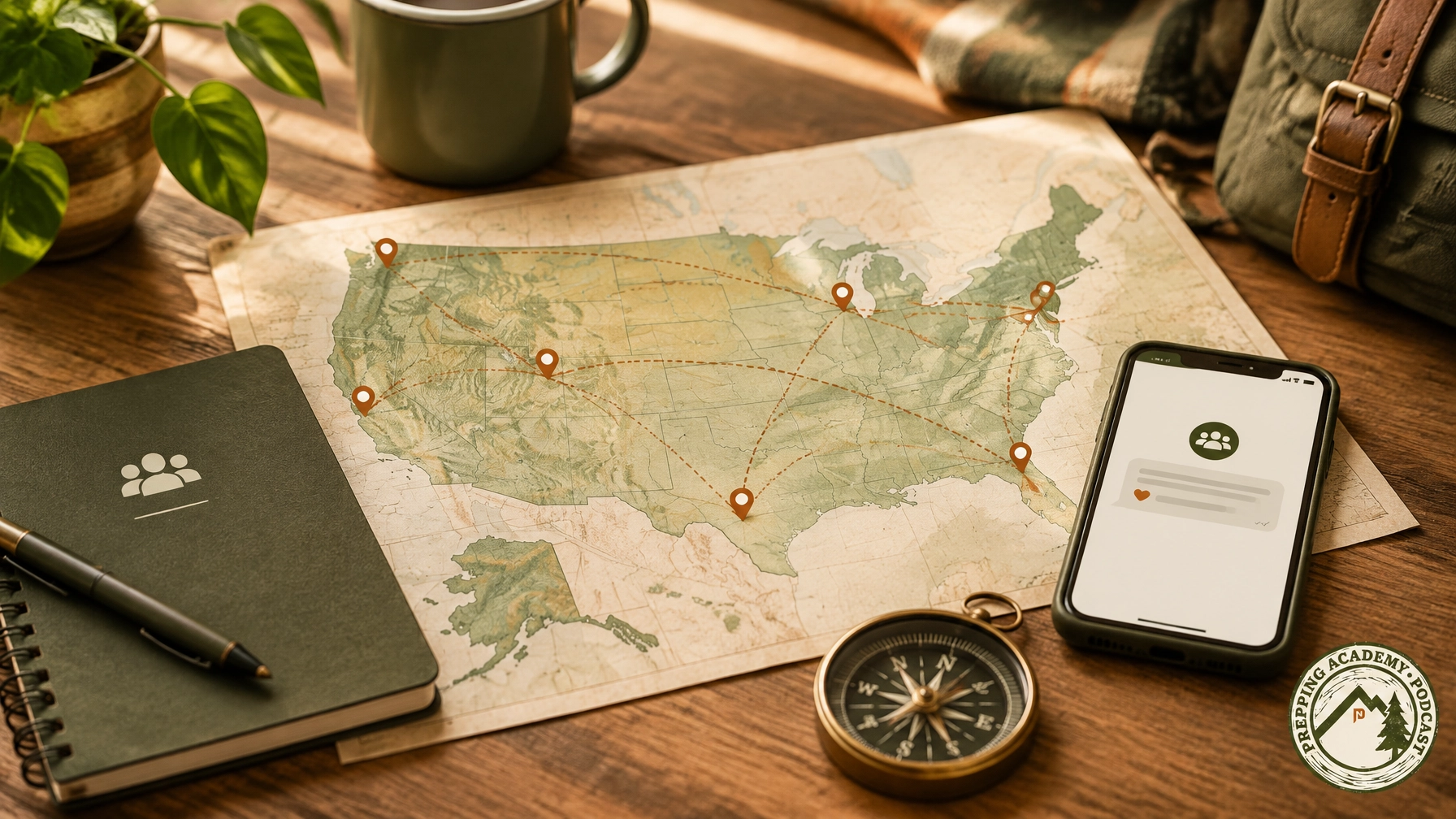
- Featured Image Alt Text: A mutual assistance group staying connected across distance with a map, contact notebook, phone, and compass
- Featured Image Caption: A clear communications plan helps a mutual assistance group stay connected when members live in different regions.