
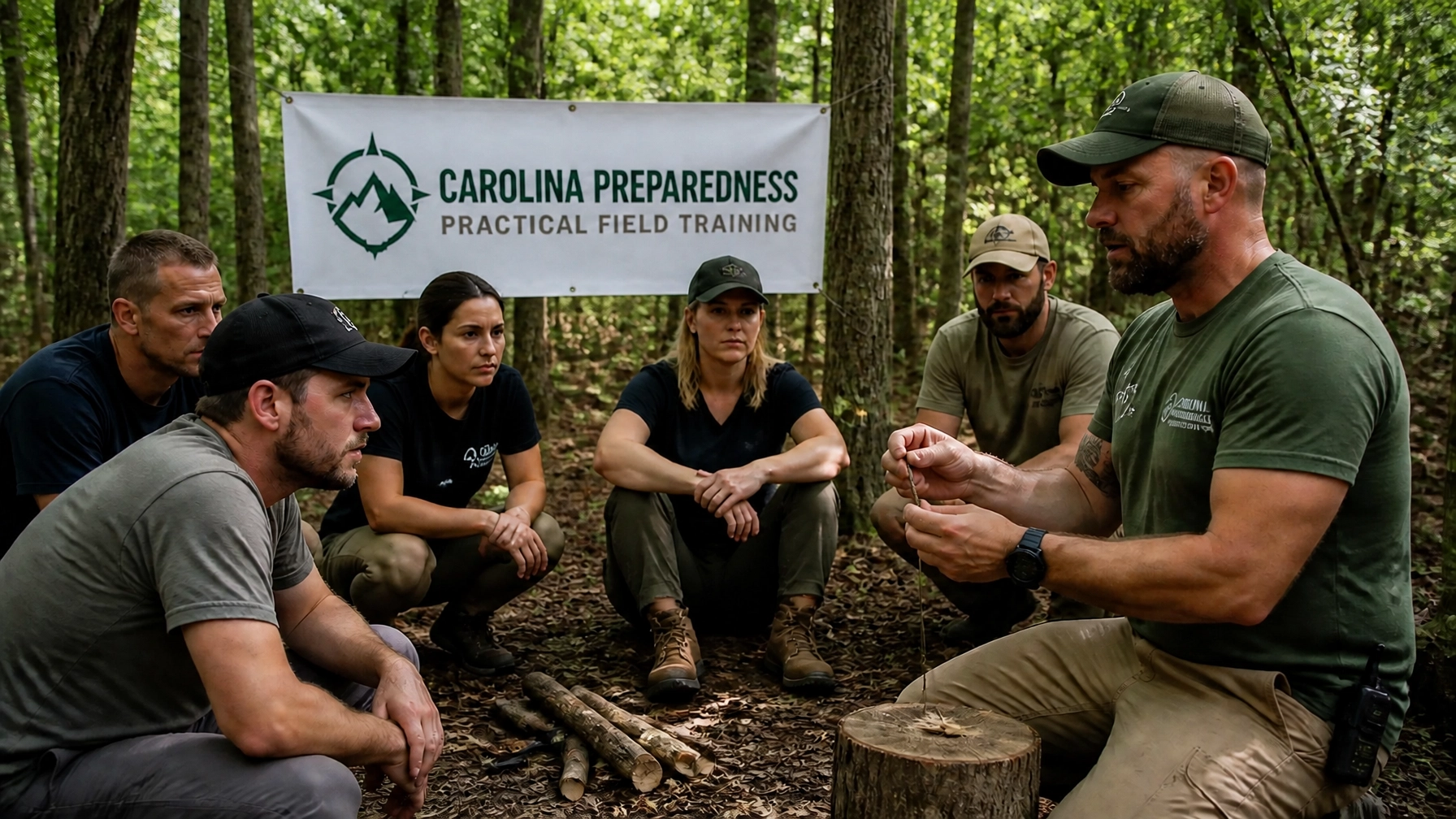
Many people picture wilderness survival courses as extreme tests of endurance. In practice, a good course is more useful and less dramatic.
You learn a small set of skills that help you stay safe, make sound decisions, and solve basic problems outdoors. You practice those skills with real materials and equipment in a real outdoor setting. That matters because reading about fire, shelter, or navigation is not the same as doing it.
At Carolina Preparedness, our field-first approach focuses on practical training for everyday people. You do not need to be an expert or an experienced outdoorsperson. You need a willingness to learn and practice.
What happens in a wilderness survival course?
Most wilderness survival courses begin with priorities. Before building anything or gathering supplies, you learn how to assess the situation.
That includes:
- What needs attention first
- How to choose a safe location
- How to protect yourself from weather
- How to manage water, warmth, and energy
- When to stay in place and when to move
- How to communicate your needs to others
The goal is not to create fear. The goal is to replace uncertainty with a simple process.
You may arrive with a full pack, but the training will show you how to use what you have. You will also learn how to improvise when a piece of equipment is missing, damaged, or unavailable.
Shelter: staying protected from the elements
Shelter is one of the first skills taught in most wilderness survival courses. Exposure to rain, wind, cold, or heat can become a serious problem before hunger does.
In a field course, you may practice:
- Choosing a suitable shelter location
- Identifying drainage problems and overhead hazards
- Using tarps, cordage, and other basic equipment
- Building a simple shelter from available materials
- Improving insulation from the ground
- Setting up a shelter that can be used safely
The focus is function. A survival shelter does not need to look impressive. It needs to help keep you dry, reduce heat loss, and give you a safer place to rest.
You will also learn that location matters as much as construction. A well-built shelter in a poor location can still expose you to runoff, falling branches, wind, or other hazards.

Fire: starting, tending, and extinguishing it safely
Fire can provide warmth, light, cooking heat, and a way to signal for help. It can also cause injuries or start a wildfire when handled carelessly.
That is why fire training includes safety from the beginning.
You may practice:
- Selecting and preparing a fire site
- Finding suitable tinder and kindling
- Using matches, lighters, and ferro rods
- Starting a fire in damp conditions
- Feeding and maintaining a small fire
- Cooking with limited equipment
- Extinguishing a fire completely
The objective is reliable fire starting: not a trick or a television challenge. You should leave with a better understanding of which methods work for you and how weather affects the process.
A course may also introduce primitive methods. However, beginner training usually places more emphasis on practical tools that you can carry and use quickly.
Water: finding and treating a safe supply
Water is a central part of wilderness survival. You need to know how to locate it, collect it, and make it safer to drink.
In Water Survival Training, students learn practical methods for working with water in the field. Depending on the course, practice may include:
- Reading the terrain for possible water sources
- Collecting water without contaminating it
- Using a cloth or other material as a pre-filter
- Filtering water with portable equipment
- Boiling water
- Using chemical treatment when appropriate
- Planning how much water to carry
The important step is practice. Handling a filter or reading instructions at home is useful, but field practice helps you understand the process under real conditions.
You also learn that clear water is not always safe water. Treatment is part of the routine.

Navigation with a map and compass
Navigation is one of the most useful skills for hikers, campers, hunters, and families who spend time outdoors. It can help you avoid becoming lost and make better decisions when a trail, road, or landmark is not where you expect it to be.
Carolina Preparedness offers Map Reading and Land Navigation, a beginner-to-intermediate course using a topographic map and a handheld compass.
You may learn how to:
- Read basic map symbols and contour lines
- Orient a map to the terrain
- Use a compass to establish direction
- Follow a bearing
- Match map features to what you see around you
- Plan a short route
- Recognize when you are moving away from your intended path
Navigation becomes clearer when you leave the table and enter the woods. You can compare the map with slopes, trails, streams, ridgelines, and other features. The skill develops through repetition.
GPS devices are useful, but they depend on batteries, settings, and sometimes satellite reception. GPS Navigation can help you build confidence with electronic tools while understanding the value of a physical backup.

Food and outdoor cooking
Food is important, but it is usually not the first short-term survival priority. A person can go longer without food than without protection or water.
Even so, wilderness survival courses may cover practical food skills. Carolina Preparedness offers Primitive Cooking, where students cook outdoors without relying on modern pots and pans.
You may practice:
- Preparing a simple meal outdoors
- Managing heat and cooking time
- Using basic natural or improvised supports
- Keeping food preparation clean
- Reducing waste
- Understanding the limits of short-term foraging
Wild plants and food procurement require careful instruction. A short course will not make someone fully self-sufficient in the wild. It can provide an introduction to local resources, safe identification, and realistic expectations.
Tools, knots, and simple field tasks
Wilderness survival depends on more than the major skills. Small tasks often determine how efficiently you can work.
Training may include:
- Safe knife use
- Basic cutting and processing tasks
- Selecting and using cordage
- Tying useful knots
- Making stakes or simple supports
- Organizing equipment
- Using fewer tools more effectively
You do not need a large collection of specialized gear. A few basic tools, used safely and correctly, can solve many common problems.
The instructor should explain why a tool or technique is useful: not simply demonstrate it and move on.
Basic safety and first response
Wilderness survival courses are not always wilderness medical courses. The exact medical content depends on the class. Still, practical safety is part of responsible field training.
You may discuss or practice responses for:
- Minor cuts and burns
- Blisters and foot problems
- Sprains
- Bleeding
- Heat concerns
- Cold exposure
- Dehydration
- Safe movement through uneven terrain
You also learn to avoid making an injury worse. That may mean slowing down, improving shelter, protecting the injured area, or calling for help instead of attempting a difficult self-rescue.
For medical certification, choose a dedicated wilderness first aid course. For general survival training, use the class to build awareness and sound habits.
Signaling and making good decisions
A useful survival course also covers how to be found. Depending on the setting, that may include:
- Using a whistle
- Choosing a visible location
- Creating contrast signals
- Using a flashlight or mirror
- Managing a signal fire safely
- Deciding whether to remain in place
- Sharing your location and plans before a trip
These skills connect to decision-making. In many situations, the best action is not the most complicated one. It is the action that reduces risk and conserves energy.
That is one reason field practice matters. You learn how tasks feel when you are standing, walking, carrying equipment, and working with other people.
What beginners can expect
You do not need prior experience for many introductory classes. Carolina Preparedness lists course-specific requirements on individual class pages, and the FAQ explains that many beginner courses require no previous training.
A one-day course may introduce the core skills of shelter, water, fire, and food. Separate classes allow you to spend more time on navigation, fire starting, water, or shelter construction.
You should expect to:
- Work outdoors
- Ask questions
- Make mistakes safely
- Repeat basic tasks
- Use common field equipment
- Learn from an instructor and other students
- Leave with skills to practice at home
You should not expect instant mastery. One course gives you a starting point. Continued practice builds speed, judgment, and confidence.
Why hands-on training is worth your time
Books and videos can introduce an idea. They cannot show you how your hands work when the tinder is damp, how quickly you lose direction in unfamiliar terrain, or how much effort a simple shelter requires.
Hands-on training helps you identify gaps before you need the skill. It also makes preparation more realistic. You learn what equipment fits your needs, what techniques you prefer, and what you should practice next.
Carolina Preparedness teaches preparedness without fear tactics or gear pressure. The purpose is simple: help you become more capable and confident.
Choose the right wilderness survival course
Start with the skill you most need to improve.
- Choose Wilderness Survival: Core Survival Skills for a broad introduction.
- Choose Emergency Shelter to focus on weather protection.
- Choose Survival Fire Starting to build fire confidence.
- Choose Water Survival Training to practice water collection and purification.
- Choose Map Reading and Land Navigation to improve direction and route planning.
- Choose Primitive Cooking to practice outdoor cooking.
Some wilderness courses may not have a date scheduled yet. You can still join the interest list through the course catalog, and Carolina Preparedness will notify you when a class is scheduled. You can also review upcoming classes.
Browse the Carolina Preparedness courses and choose a skill to practice next.
SEO fields
Excerpt: Wilderness survival courses teach practical field skills such as shelter building, fire starting, water purification, navigation, outdoor cooking, and basic safety through hands-on practice.
SEO title: Wilderness Survival Courses: What You Learn in the Field
Meta description: Learn what to expect from wilderness survival courses, including shelter, fire, water, navigation, outdoor cooking, and practical field safety.
Focus keyword: wilderness survival courses
Featured image alt text: Students learning wilderness survival skills in a North Carolina woodland during a Carolina Preparedness field course
Tags: wilderness survival courses, wilderness survival training, survival skills, outdoor training, fire starting, water purification, land navigation, preparedness training, Carolina Preparedness