
Children do not need frightening stories to learn useful outdoor skills. They need simple instructions, patient practice, and adults who show them what to do. A child who has practiced how to stay with a group, recognize a trail, or ask for help is better prepared, and can enjoy being outdoors with more confidence.
That is the purpose of youth and family survival skills training: to build practical habits in a calm, age-appropriate way. It is not about making children responsible for emergencies. Adults remain in charge. Children learn a few clear actions they can remember and practice safely.
What children can learn outdoors
Good instruction starts with basic safety and builds toward hands-on skills. The exact activities should fit a child’s age, attention span, and experience. At Carolina Preparedness, the Youth Survival Skills Basics course is a one-session outdoor clinic introducing young people to shelter, water, fire, and food through practical activities.
Navigation basics
Children can learn to recognize trail markers, notice landmarks, and follow a simple route with an adult. A map and compass exercise can be an enjoyable way to practice paying attention to where the group is going.
The goal is not to send children off on their own. It is to help them understand the route and feel comfortable asking questions. Parents can reinforce this by pointing out landmarks on family walks and talking through the route before setting out.

Shelter, warmth, and weather
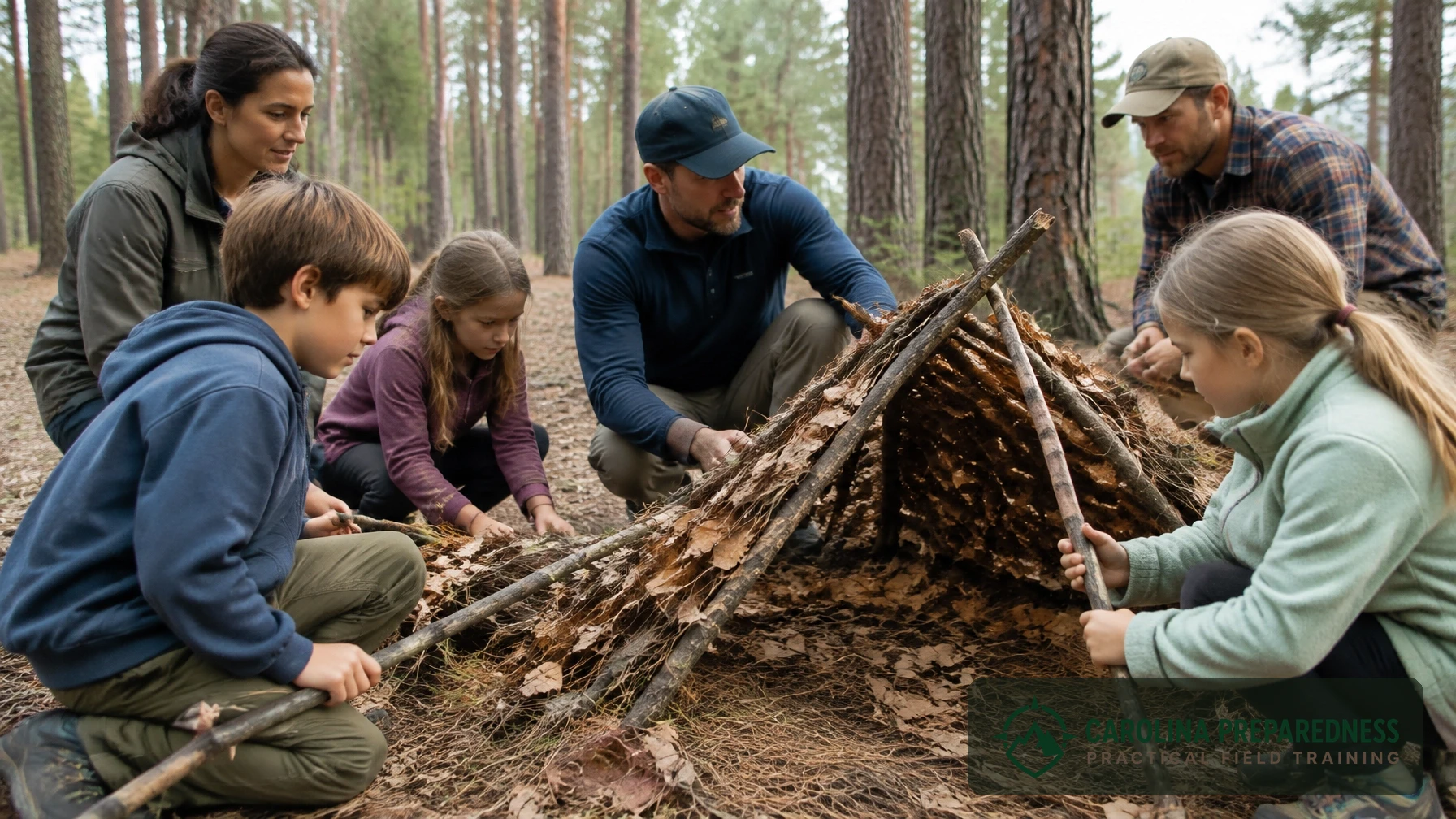
A simple shelter lesson can show children how to think about shade, wind, rain, and staying dry. They can help gather suitable materials and build a basic shelter under supervision.
This is also a chance to talk about clothing, carrying water, and letting an adult know when they feel cold, hot, or uncomfortable. The lesson is practical: notice the weather, use the supplies available, and work with the group.
Fire safety with adult supervision
Fire skills must be taught with clear boundaries. Children can learn why fires need adult supervision, how to keep a safe distance, and why a fire must be fully extinguished. Any fire-starting or cooking activity should be managed by an instructor or responsible adult.
For younger children, a safety discussion or demonstration may be more suitable than handling fire-starting tools. Adults should follow local rules and fire restrictions. The U.S. Fire Administration’s guidance on children and fire safety offers useful reminders for families.
Water awareness
Water lessons can begin with simple habits: stay with the group, ask before approaching water, and tell an adult if someone is missing or in trouble. Children should know that they are not expected to enter water to help someone. They should call an adult and follow the plan they have practiced.
In a wilderness skills class, an instructor may also introduce how to think about drinking water. Children should understand that water from a stream or pond is not automatically safe to drink; they should follow an adult’s instructions. For more family guidance, review the American Red Cross water safety recommendations.
What to do if separated
A short, repeated plan is easier to remember than a long list of instructions. Children can practice stopping in a safe place, taking a breath, calling for their adult, and staying visible. They should not wander off to search for the group or hide from people looking for them.
Explain that being separated is not a reason to feel ashamed or afraid to ask for help. An adult can say, “Stop, stay where you are if it is safe, and call for me.” Families can agree on a plan before a hike and review it again when they arrive. AdventureSmart’s Hug-A-Tree program is another resource for teaching children what to do if they become lost outdoors.
Parents are part of the learning
Parents help make the skills stick. Before class, tell children what to expect and remind them that the instructor is there to teach, not test or scare them. Let them know that asking for help is a good decision.
During a family activity, adults can model calm behavior, listen to instructions, and give children time to try a task. Offer support without taking over every step. A child who helps choose a safe spot for a shelter or identifies a trail marker is practicing observation and teamwork as well as an outdoor skill.
After class, ask a few simple questions: What did you practice? What would you do if you could not see the group? Which activity would you like to try again? Keep the conversation practical and reassuring. The point is to remember useful actions, not to make children worry about unlikely scenarios.

What a family class day might look like
A typical day depends on the course, weather, group, and location. Carolina Preparedness lists several youth and family options, including the Youth Survival Skills Basics clinic, School Break Day Camp, and the recurring Homeschool Outdoors Adventure Program.
A one-session survival clinic may move between short demonstrations and hands-on activities. Students might practice building a simple shelter, discuss how to think about drinking water, learn safe fire-starting fundamentals, and get an introduction to wild-food awareness. Activities are designed to be approachable for outdoor newcomers while still giving more experienced children something to work on.
Parents can help children prepare by choosing weather-appropriate clothing, sturdy shoes, water, and a snack. Check the course page for its current list of what to bring and any specific instructions. A class may have a different schedule or activities depending on conditions, so avoid promising children a particular station or skill unless the course description confirms it.
The best learning comes from a steady pace: listen, try, ask questions, and practice again. Small-group instruction gives children room to participate and get guidance. The setting is outdoors, where students can work with real materials and learn by doing rather than only hearing about a skill.
Choose practical training, not pressure
When choosing survival skills training for a child, look for clear course details, adult supervision, and activities that match the child’s readiness. Ask the provider about age guidance, parent participation, and how fire and water activities are managed. A good class should welcome beginners and explain safety rules plainly.
Carolina Preparedness is led by instructor Forrest Garvin, who has more than 25 years of teaching experience and has trained over 2,000 students across the Carolinas. The approach is practical and calm: help students build capability without fear-based messaging.
At the time of writing, the youth courses are listed in the catalog but do not show scheduled dates. Browse the Youth & Family courses and upcoming classes to see current availability. If the course you want is not scheduled, the catalog offers an interest list for notifications when new dates are added.
Start with one skill, practice it together, and keep the next step simple.
Excerpt: Youth survival skills training can help children build outdoor confidence through calm, supervised practice. Learn what kids may practice and how parents can support the experience.
SEO title: Youth & Family Survival Skills Training | Carolina Preparedness
Meta description: Learn how youth and family survival classes teach children practical outdoor skills through calm, age-appropriate, hands-on instruction.
Focus keyword: survival skills training
Featured image alt text: Children and parents practice building a simple shelter during an outdoor survival skills class.
Tags: survival skills training, youth survival skills, family outdoor training, youth survival classes, wilderness skills, Carolina Preparedness